
What have you learned lately?
Regardless of whether it came through a book, conference, podcast, blog post, or other, what have you learned lately?
In most cultures, the epitome of learning is a university with its lectures.
This even though lectures don’t lead to a whole lot of learning.
Students tend to only remember the beginning and end of lectures.
Yet without learning, we’d be the same sac of skin and bones we were born with, with no ability to walk or talk, read or write.
Learning is paramount.
Yet we pay precious little attention to it.
Until now.
I’ve spent a lifetime focused on learning. How to make it inclusive, engaging, and practical. How to make learning useful and usable.
Powerful learning has a lot to do with the trainer/teacher.
But it also has a lot to do with you.
Here are three steps to making your learning powerful.
They’re designed to remove the friction (a term used in healthy habit formation) or barriers to learning.

1. Capture
- Most people focus on the ‘container’ for the learning – the conference session, the book, the podcast, etc. but pay little attention to how to capture learning.
- How do you capture your learning so you can get the learning to ‘leave the room’?
- How do you capture your learning so you can be kind to your future self and find it later on?
- I use a variety of tools to help my workshop participants capture their learning. Check out the section below for links so you can try them yourself.
2. Organize
- You’ve done the workshop, listened to the podcast, you’ve learned some good stuff. Now what?
- How do you organize your learning?
- If I asked you to share with me your learnings from 2023 would you be able to do so easily and quickly?
- Put a system in place to organize your learning. It’s absolutely critical for the next step.
- It doesn’t have to be and shouldn’t be complicated by the way.
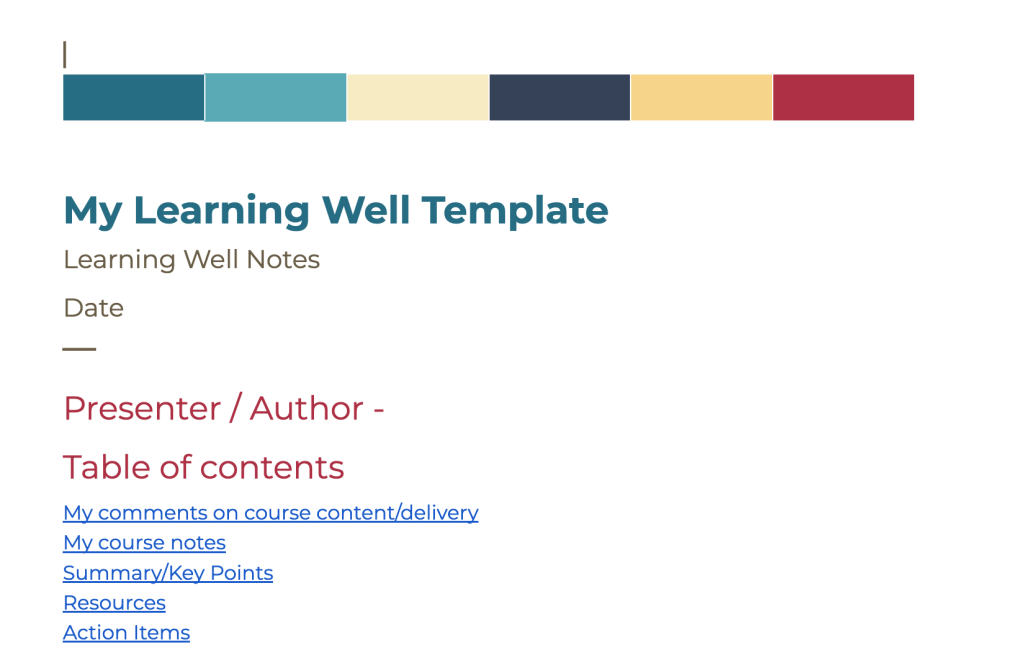
- I use a Google Doc template I made for each and every workshop I take. It makes organizing my learning a snap. I’ve included the link to it below.

3. Apply
- It’s one thing to set aside time for learning, it’s another to organize your learning but it’s critical that you actually apply your learning, otherwise, it stays in the land of theory only.
- What are you doing to help yourself apply your learning?
- Again, this shouldn’t be difficult.
- In the Google Doc template I talked about above, there’s a section for action steps. Easy peasy.
Unless you’re a hermit living in a distant cave with no access to other humans, then learning should play a large role in your life.
Do yourself, and us, a favour by ensuring you have simple systems to capture, organize, and apply your learning. The world will be better for it.
Now go on and learn, laugh, and lead
Learn
- Here are four tools you can use to capture your learning. Once you download them they become editable for your use.
Laugh
- There’s nothing like someone else peeking into another’s culture for great, and in this case, funny, learning.
Lead
- Download the four tools, pick the one you like the best, and use it for your next conference, workshop, etc.
P.S. For UN Staff only
- I’m leading two online workshops for UN staff. One on Work-Life Balance (April 17/18 and May 15/16, for two hours each and one on Effective Online Presentations (April 17/18, May 14/15 and June 19/20). Click on the links for more information including how to register.
- If you’re not a UN staff but you’re interested in the courses please reach out!
- Here’s what past participants have said:
- On WLB: What did you enjoy the most? Everything. Lee-Anne is a star
- On Effective Online Presentations: It was actually very interesting and I loved the content and way it was delivered Lee-Anne is so gifted in giving trainings.


Leave a Reply