
I was talking to a dear friend a while ago. She’s an incredibly bright, very successful professional who manages a massive budget, a big team, and she works and lives interculturally, away from her passport country.
If you put a problem or challenge in front of this person, she will overcome it with panache. She’s resilient and kind and huge-hearted.

But she’d hit a wall.
She was facing a conflict at work.
With a dude.
A dude who didn’t respect her, most probably because she is a woman.
We chewed over a few options for moving through, around, and over the conflict.
Which made me think you might find the options helpful as well.
Breakthrough Strategies: Four Tools to Resolve Any Conflict
Here are four tools to help you when you hit a wall with conflict. I’ll cover two in this post and two in the next post.

1. Fight, flee, flow
What is it?
I’ve used this simple diagnosis tool so many times. It’s from a book called “As above, so below,” where the author asks you to figure out which of the following three spaces you’re in.
It’s not a static tool; you can be in one space one day and switch the next, but it’s a handy way of figuring out how to react in the moment.
- Fight – you’re feeling fiery and willing to address the issue head-on. All jets are firing. Bring it on. This is important to you. You’re ready to dive in and address the conflict directly. (I know you know this, but in case there’s any doubt, this does not actually mean physically fighting!)
- Flee – for safety reasons (including perhaps your mental health) you need to remove yourself from the situation. Get outta there. You can come back later if you wish, but for now, it’s sayonara.
- Flow – this conflict is bugging you, but it’s not under your skin. You have more important things on your mind and in your heart. You’re electing to go with the flow. Caveat: If you select this one, it’s important to truly go with the flow, and to not be under the illusion that you’re going to let things go when really, you’ve got your knickers in a massive knot.
Pssst. Does this tool sound familiar? You may recognize it as a simpler version of the Serenity Prayer, which makes it all the sweeter.
When to use it: when you need to decide how important the issue is to you and your preference for responding.
2. Will and/or skill
What is it?
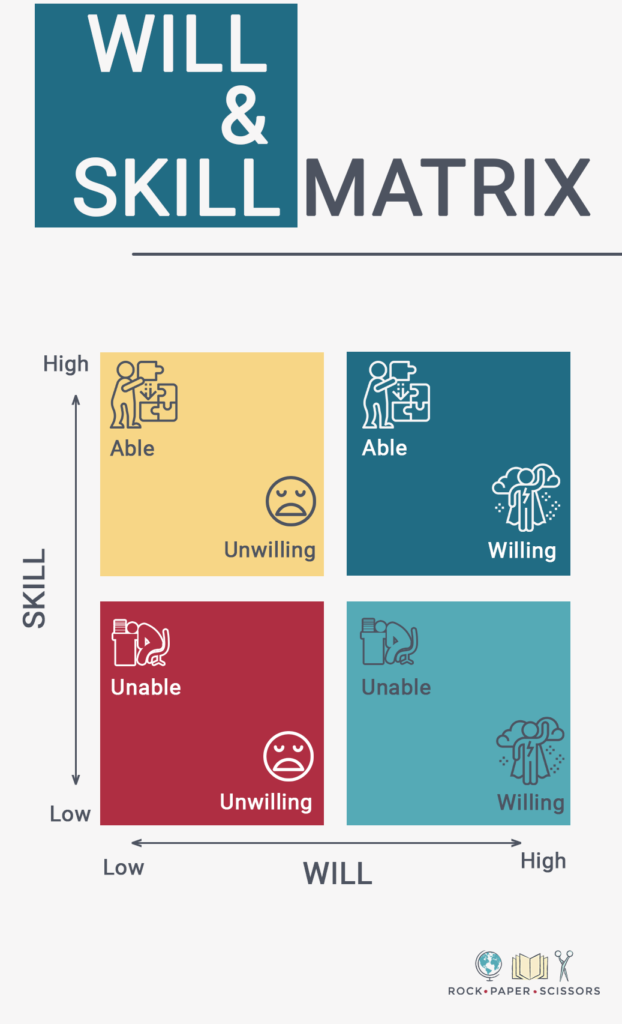
This is another tool that I’ve used myself and taught to many. It divides the conflict into one of four categories. Once you’ve figured out which category the conflict is in, it points the way forward.
It compares two things, which then create four possible categories:
Will:
- Are you and/or the person you’re in conflict with willing to address it?
- Do you have the motivation, the willingness to address the conflict?
- Are you motivated to resolve it?
- If your answer is yes, that’s fantastic. You’re halfway there, as you’ve got willingness on your side.
- If your answer is no, then motivation needs to be part of the equation moving forward. Ask yourself what would motivate you and/or the other person?
Skill:
- Are you and/or the person you’re in conflict with skilled?
- Do you have the skills to resolve the conflict?
- And/or is the conflict being caused by a lack of skills (not necessarily related to conflict resolution)?
- If your answer is yes, that’s fantastic. You’re halfway there, as you’ve got skills on your side.
- If your answer is no, then training/ Learning and Development needs to be part of the equation moving forward. Ask yourself what skills you and/or the other person need and how you’ll address this.
Those two things (will and skill) give us four possible categories:
- Lack of will + skilled
- Lack of will + unskilled
- Willing + skilled
- WIlling + unskilled
When to use it: when you need some insight into what’s causing the conflict.
The next time you find yourself bumping into a roadblock when it comes to conflict, feel free to use the fight/flee/flow and will/skill tools to come to your rescue.

You’ve got more options than your brain might be trying to convince you of.
Then check back for part two, where I’ll invite you to R.I.S.E. and get an A.A. (it’s not what you think).
Now go on and learn, laugh, and lead

Learn
- Click on the links above for more information on fight/flee/flow as well as the will/skill matrix
Laugh
- Conflict can leave us feeling feisty, kinda like this little baby elephant.
Lead
- Share the tools with a friend or colleague and discuss how you’ll use them.
P.S.
- Have a burning topic of yours that you’d love to share with the world? Check out my Transformative Trainers Academy – for game changers like you who want to learn how to design and deliver world-changing workshops that wow. Join our global online community membership program now. We’re waiting with open arms.
P.P.S.
- Are you a UN staff member wanting to brush up on your public speaking skills in a way that’s actually fun, enjoyable, and leads to a marked difference in your confidence? I’ve got you. I’m giving a two-part workshop on March 24 and 25, 9 am to noon EAT. You can find more information here and email unon-hrlearning (@) un.org to register and get information on cost.
- Not a UN staff, but you’re interested in improving your public speaking skills? Email me (laragan @ rpsinc.ca) – I’ll add you to the list as others have expressed interest as well. We may do a separate workshop.


Leave a Reply