
“If I catch anyone with your hands in your pockets, you’ll need to do ten pushups in front of the whole room,” proclaimed the instructor, in a room of about a hundred people. True story. This was some thirty years ago, when I went to a sports coaching clinic.
Do you know what I remember from that workshop? Nothing. Except where my hands were. I worried about that ALL weekend.
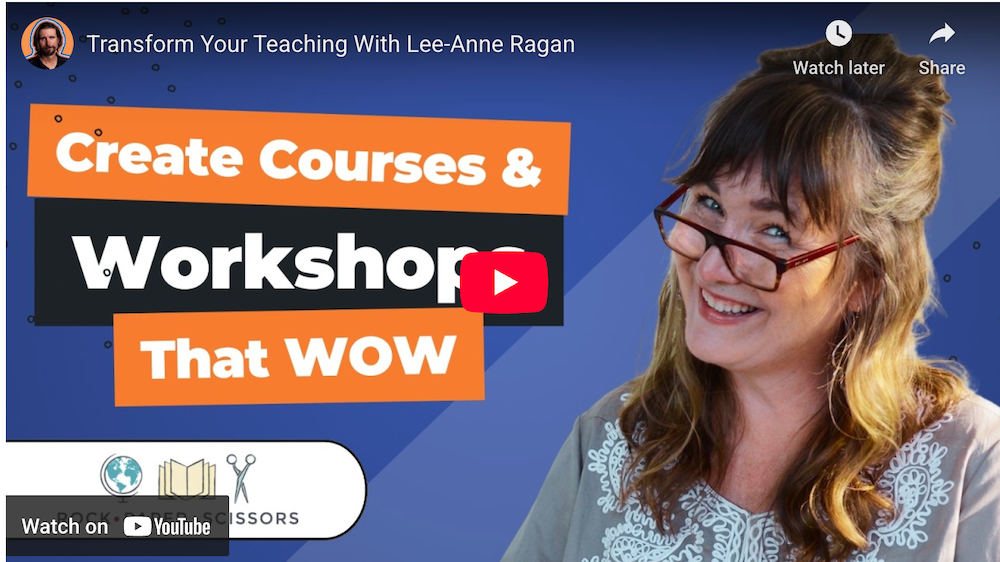
This is one of the things I talked about as a guest of Chris Badgett’s on his LMSLifter podcast, about how to make your courses and your workshops more engaging. Keep reading for four tips total.
When learning feels threatening the brain shifts into self-protection mode.
Curiosity disappears.
And no matter how good your content is, none of it lands.
After 40 years, teaching 55,000+ participants from more than 150 countries — from UN conflict zones in Somalia to C-suites in Canada — this is the lesson that sits at the centre of everything I teach.

Engagement takeaway tip 1
Participants have to feel calm, welcomed, and included in order to learn (regardless of whether their hands are in their pockets or not!). Shaming and embarrassment have no role in engaged learning.
—————————————————
The question that changed how I design everything
Sometimes, the best thing you learn as a Learning and Development expert comes from your participants. Here’s an example.
Years ago, I was running a United Nations, competency-based workshop in Cairo for folks from all over the world. Partway through, two participants came to me with a question I wasn’t expecting.
They said, “Lee-Anne, if we don’t have this particular competency, does that mean we’re incompetent?”
I thought about it for a month, and it led me to design a framework I’ve been using ever since.
I call it S.A.K.E.
S — Skills. What can participants actually do after your workshop?
A — Attitude. Mission, values, motivation. Feeling connected to the “why” of I’m here. The connection makes the difference between a reluctant participant and an engaged one.
K — Knowledge. The theory, frameworks, and research behind what you teach.
E — Experience. How participants use your content after the course is over.
I’ve surveyed participants from all over the world for years on what is most important to them when they take a course or a workshop: skills, attitude, knowledge, or experience.
The same answer comes out on top every single time.
It’s Experience.
People don’t just want to learn something — they want to use it, well after your course or workshop is over.
And yet the crime?
Experience is the thing most trainers, coaches, and course creators leave out entirely. (Enter stake to the heart here.)

Engagement takeaway tip 2
Build in ways to support your participants using their learning long after they’ve left your ‘classroom’ (whatever form that takes for you.)
—————————————————
The 3-for-1: before, during, and after
Most of us pour everything into “during” the workshop itself, the course content, the live session. But the learning that lasts? It’s built before you start and reinforced after you’re done.
Before: give participants a way to show up ready. A simple tool to capture their own context and goals works wonders.
After: the real magic happens when you’re no longer in the room. Deliberate community (a Facebook group, a cohort space), challenges, even Easter eggs hidden in your materials — anything that pulls participants back to the content and raises their curiosity — all of it extends the learning far beyond the session itself.
Because curiousity is one of the strongest drivers of retention and because the person who attended your workshop on a Monday morning is a different person two Fridays later, pay attention to the ‘after,’ and you can still be teaching them long after you’ve both left the room.

Engagement takeaway tip 3
Triple your engagement by engaging participants before and after your workshops.
—————————————————
The one skill that increases engagement everywhere and with everyone
Whether you’re training UN peacekeepers or teaching dog owners, the most important thing you can do is the same: massage your participants’ amygdalas.
Say what?
The amygdala (Greek for “almond”; because that’s what it looks like) is the part of our brain that decides: am I safe enough to learn?
When we feel embarrassed, excluded, or threatened, it grows to walnut size, and learning simply stops.
When someone shows up to learn from you, they’re making themselves vulnerable. They’re saying: I don’t know this thing yet, and I’ve chosen you to help me.
That’s an enormous act of trust.
Your voice, your pacing, your welcome — these aren’t soft extras. They’re the foundation on which everything else is built.

Engagement takeaway tip 4
Hone your “almond massaging” skills, a.k.a. helping your participants to feel included, welcomed, and comfortable, and your content will fly.
—————————————————
All four of these tips — and more — are waiting for you in the full podcast. Tune in for a deeper dive into:
- Ditching any whiff of shame and embarrassment from your learning space
- Building in ways for participants to apply their learning long after the workshop is over
- Weaving in engagement strategies before you even start — and after you finish
- Practising your almond massaging skills
—————————————————
Want to go deeper?
The Transformative Trainers Academy is a global online membership for coaches, facilitators, trainers, and course creators who want to design and deliver workshops that actually stick. If you have expertise worth sharing and you want to share it better, come and have a look.
And if you want to hear the full conversation with Chris Badgett, including the Easter egg story, and get access to resources, including my S.A.K.E. survey, you can take to find your own preference, the LMScast interview is right here.
Lee-Anne Ragan is a learning and development expert with 40 years of experience teaching 55,000+ participants across 150+ countries. She is the founder of the Transformative Trainers Academy and the L&D Roundtable.
Now go on and learn, laugh, and lead

Learn
- Find all the goodies, including the podcast, a tool to help you remember what you learn, and a worksheet with lots of resources you can dive into based on how much time and energy you have.
Laugh
- Massaging almonds or funny bones for that matter, is powerful!
Lead
- Check out the Transformative Trainers Academy and consider joining us – a sweet spot for change makers who want to design courses and workshops that wow.


Leave a Reply