
Where Do Your Eyeballs Land? A Simple Design Check for Trainers and Facilitators
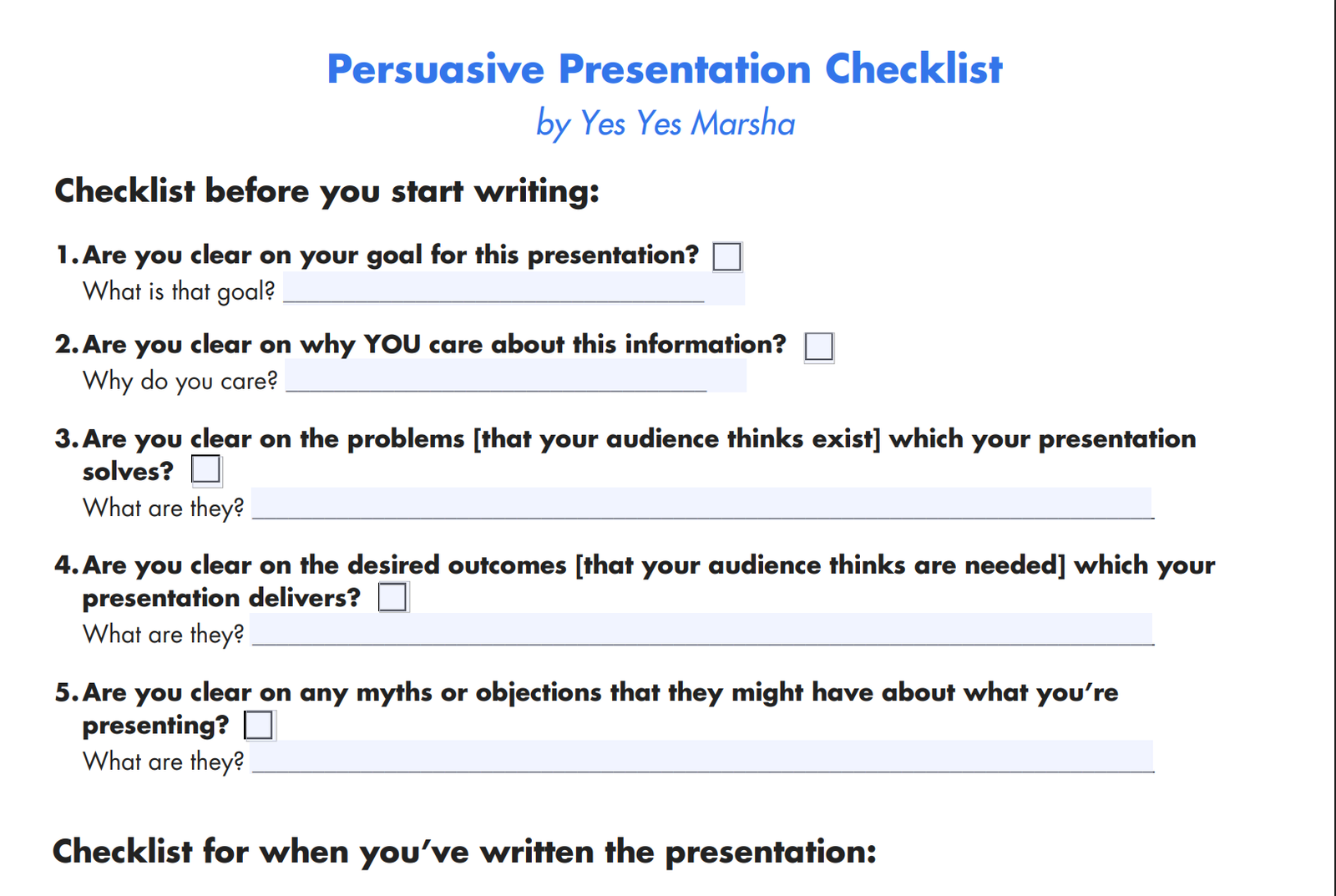
Marsha Shandur, a fabulously funny and bright colleague …someone I have a monthly catch-up call with … recently showed me a worksheet she’d designed. That’s part of it above (shared with permission, of course).
The moment I looked at it, I could feel my eyeballs being dragged to the end of each line. To the checkboxes.
That felt weird. And off.
Here’s the backstory.
Years ago, when I was working with unemployed adults at an NGO, part of my job was to run resume-building workshops. The same issue kept coming up, and it was making me cross-eyed.
When participants asked me to review their resumes, my eyes would inevitably land on something irrelevant.
Something unimportant.
I realized it all came down to design.
We’d been so focused on content that we’d completely neglected how the resume actually looked.
It was like having a super smart, ambitious, well-spoken person show up dressed in dirty, ragtag clothes.
In that case, what would your eye be drawn to first?

I’m pretty sure it wouldn’t be their sparkling personality.
So I designed a simple, easy technique.
I asked everyone to hold their resume, close their eyes, or let their gaze soften, and count to three. Then open their eyes and tell me…
Where did your eye land first?
Was it on something strategic? Something that made them shine? Or something irrelevant — like a checkbox?
We’d pass the resumes around, and surprisingly, or maybe not, everyone’s eyes landed in the same place.
Then we got to work editing the design so that where the eye landed first was somewhere that made them shine, not shy away.
The same principle applies to any written or online content you put in front of someone.
Try it yourself right now. Pull up a worksheet, a report cover page, a website, whatever you have handy.
Close your eyes.
Take a nice deep breath or two (bonus: micro-meditation moment!).
Now open your eyes and see (get the pun?) where they land.
Is where your eye lands something important? Something that makes you or your work shine? If so, yay you.
If not, adjust the design and try again.

Often, a simple font size change or a bit of bold is all it takes.
Design can be a big, complicated topic, just like teaching.
But it doesn’t have to be.
Use the eyeball-landing principle next time you want to check your design. It’s super simple, quick, and surprisingly powerful.
Want to take your learning design even further? Check out Design a customized learning plan for 2026 that fits you to a T for more practical tools you can use right away. It’s one of the free monthly Learning and Development Roundtables I’ve been hosting for more than 13 years, and there’s a whole archive waiting for you. Join as a free member now to get access to all of them.
Looking for more tips and techniques to take that important subject matter expertise of yours and turn it into a workshop that wows?
Check out the Transformative Trainers Academy, a global community of changemakers who want to change the game when it comes to how the world learns.
Here’s how to put this into practice.
Go on and learn, laugh, and lead

Learn
- Use the eyeball-landing technique on one piece of your content today: a worksheet, a slide, a report cover. Just one. See where your eye lands and edit your document if it’s not somewhere strategic.
Laugh
- Rachel clearly didn’t use the eyeball landing technique. Catch the funny resume fail and flounder from Friends.
Lead
- Share this post with a fellow trainer, facilitator, or colleague who designs learning materials, and do the eyeball test on each other’s work.
P.S.
- The eyeball test is a great start. But if you’re ready to transform the way you design and deliver learning altogether, the Transformative Trainers Academy is waiting for you. A global community of changemakers, ready to change the game.
- And if you enjoyed today’s post, you might also like Ten insider lessons from launching the Transformative Trainers Academy, a behind-the-scenes look at what TTA is all about.
- And if you’re a UN staff member who wants to increase your public speaking skills, I have great news for you. I’m teaching a two-part online workshop on May 20 and 21. Head over here for more information, including how to register.


Leave a Reply