
In my work with trainers and leaders around the world, I’ve noticed a pattern.

The people who actually follow through on their goals aren’t necessarily more talented or more motivated.
They just asked better questions upfront.
Meet Priya. She’s a talented trainer who has been dreaming about launching her own signature program for over a year. She knows her content. She knows her audience. But somehow, the program keeps not happening.
And meet David. He’s been telling himself for months that he needs better boundaries — with his time, his energy, and yes, his phone. He’s tried app timers. He’s tried leaving his phone in another room. Nothing sticks.
What’s missing for both of them isn’t willpower or skill. It’s a framework. Specifically, five questions that — when answered in order and answered honestly — turn a fuzzy intention into a real plan.
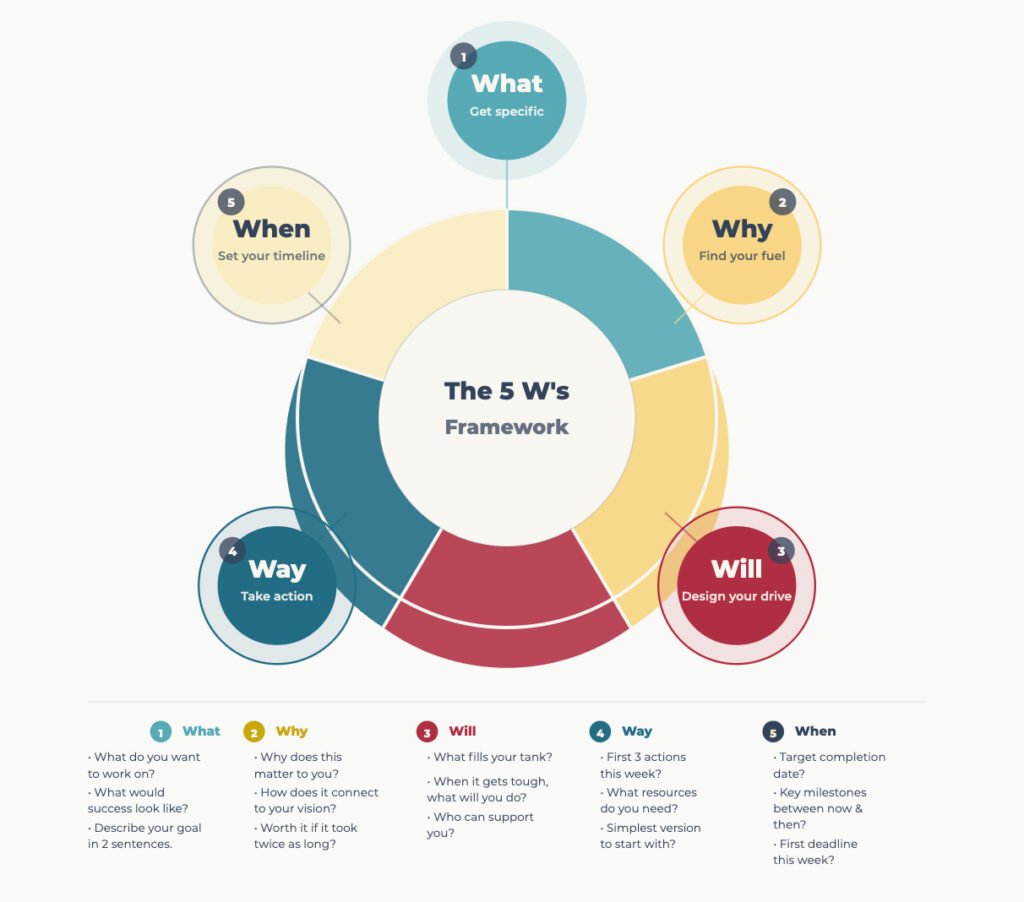
I call it the 5 W’s.
And whether you’re building something professionally or trying to protect your own wellbeing, it works the same way.
I’ll cover the first two W’s in this post and the other three in the next post.
W #1: What
The first question sounds almost too simple: What do you want to work on?
But simple doesn’t mean easy. There’s a big difference between a vague intention and a clear, specific goal — and most people never bridge that gap.
Priya knows she wants to “launch a program.” But what kind of program? For whom? Delivered how? In what format? David knows he wants “better boundaries.” But with what, exactly? Work emails after hours? Scrolling before bed? His relationship with his phone in general?
Without specificity, you don’t have a goal. You have a wish.
What happens when you skip this W: You stay busy without making progress. Priya spends months researching other people’s programs without ever defining her own. David downloads another app and wonders why it doesn’t help. Motion without direction isn’t momentum — it’s just movement.
So ask yourself:
- What exactly do I want to create, change, or achieve?
- If I had to describe this goal to someone else in two sentences, what would I say?
- What would your D.O.D. (definition of done) look like? What does success look like?

W #2: Why
This is the W that almost always gets left out. And it’s the one that matters most.
Knowing what you want to do is the starting point. Knowing why it matters to you is the fuel. Without it, you’ll make progress when things are easy and stall the moment they get hard.
Your Why isn’t just a motivation — it’s a compass. It connects your goal to something bigger: your values, your vision, the kind of professional or person you’re working to become.
Priya wants to launch her program because she believes trainers deserve better support than they’re currently getting. That belief is bigger than any one program — it’s her mission.
David wants better boundaries because he’s noticed he’s distracted and irritable with the people he loves most. That’s not a screen time problem. That’s a values problem. And naming it changes everything.
What happens when you skip this W: You hit your first obstacle and have nothing to pull you forward. Priya gets busy with client work and the program slides to the back burner — again. David has a stressful week, and the boundaries dissolve overnight. When the Why is missing, every setback becomes a reason to quit.
So ask yourself:
- Why does this goal matter to me right now?
- How does it connect to my bigger vision or mission?
- If this goal took twice as long as expected, would the Why still be worth it?
Let’s pause here so you can gather your first two W’s – What and Why. Then continue with part two, for the other three W’s.
Talent and motivation will only take you so far. The people who follow through aren’t different from you — they just asked better questions. Now you know which ones (at least the first two). Again, stay tuned for the next three..
Take Action Now – go on and learn, laugh, and lead

Learn
- The 5 W’s aren’t just a goal-setting tool — they’re a diagnostic. If something in your life or work keeps stalling, chances are one of the W’s is missing. Go back and find it.
Laugh
- We have all been David. We have all downloaded the app, set the timer, lasted four days, and declared the whole experiment a failure. You’re not broken. You just skipped a few W’s. Or maybe you’ve simply had an app fail.
Lead
- The next time someone on your team — or in your training room — comes to you with a goal that isn’t moving, don’t jump straight to tactics. Ask them which W they haven’t answered yet. That question alone can change everything.
P.S.
- My next free Learning and Development Roundtable is on June 18th. Have you grabbed your spot yet? These sessions are one of my favourite ways to think out loud with a global community. More info here on this month’s topic – AI Prompting Skills: How to Ask Better Questions and Get Better Results. I’d love to see you there.


Leave a Reply