
“I see you too.”
Four words, said quietly over my shoulder, which I’ve never forgotten.
If you’ve ever walked into a room to teach, facilitate, or untangle a conflict and wondered how to really see the people in front of you, without boxing them in or glossing over what matters, this post is for you.
Or maybe you’re faced with a really diverse room, and you’re thoroughly overwhelmed and not sure what to keep on your radar and what not to.
By the end, you’ll have a simple three-circle check you can use the next time a conversation heats up, a group gets stuck, or you’re designing a session for people you’ve never met.
Consider it your guide to staying out of the I.C.U.
Where my I.C.U. tool came from
Back in 1999, for my master’s in education, I decided to focus on intercultural conflict resolution. I noticed when chatting with organizations who I thought would have intercultural con res tools, that they didn’t.
When I asked about their tools, they’d inevitably say, “We don’t have any; please call us when you’re done.”
Okay then.
That led me to design my I.C.U. tool, which I’ve been using and teaching ever since.
I originally named it I.C.U. As in Individual, Cultural, and Universal. More on that in sec.
But fast forward to the day a participant leaned over my shoulder, looking at the handouts, and said, “I see you” too.
I.C.U. = I See You
It was such a lovely moment.
Because that’s the whole point, seeing isn’t a one-way street. When we really see each other, it goes both ways.
The tool has travelled with me to conflict resolution sessions, communication workshops, and training-of-trainers programs around the world, including for a bunch of UN teams.
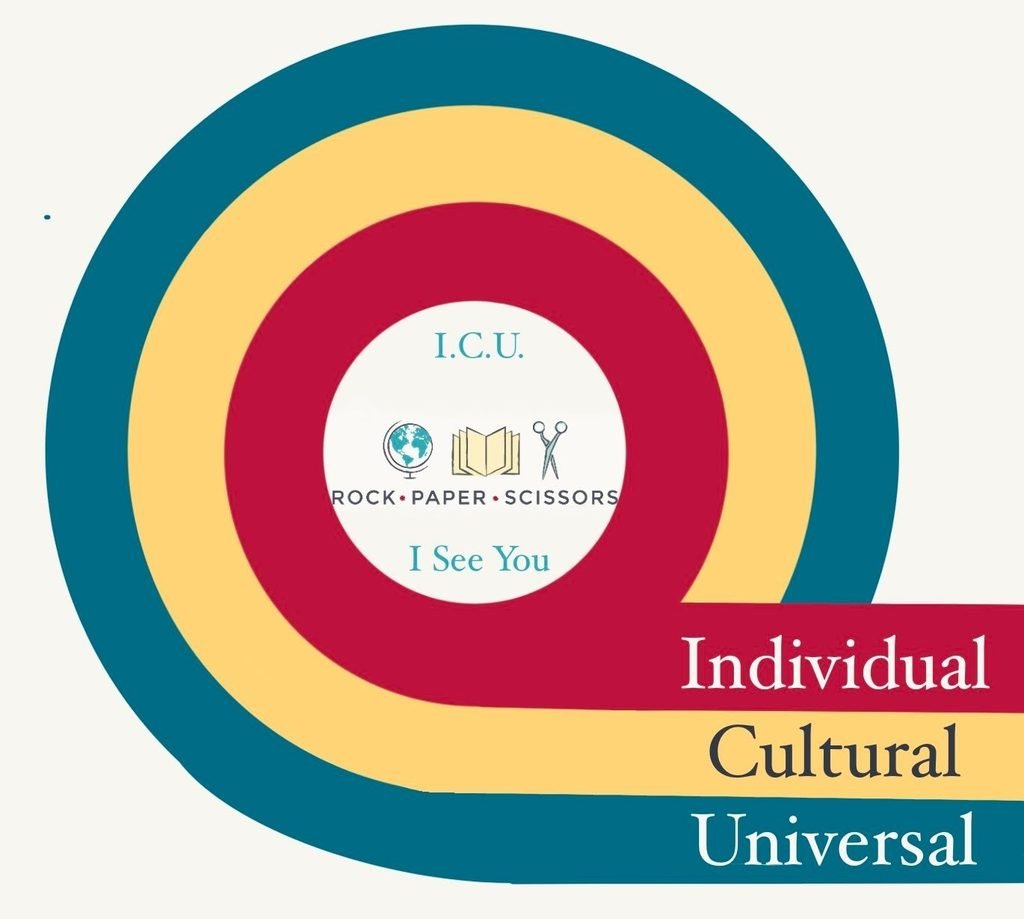
The three circles of I.C.U.
I see you
Or how to stay out of the I.C.U. (intensive care unit) by seeing someone fully .
Three disparate things are true at the same time:
- There has never been anyone exactly like you, dear reader, and there never will be; you are a unique individual
- You belong to and have lots in common with some groups, based on your cultures.
- As a human being, you have something in common with everyone. You have a universal need for respect and belonging, for example.
The Individual circle (the centre)
This is the unique person in front of you. Their gender, their personality, their preferences, how they like to make decisions, where they are in their own learning, etc.
The Cultural circle (the middle)
This is the context the individual sits within. The when, where, who, why, and how of the situation. The culture of the room, the organization, the community.
The Universal circle (the outside)
This is what connects all of us. Human rights. Decisions based on human needs.
Simple, right? Here’s where it gets interesting.

The danger of looking through only one circle
Most of us have a favourite circle. We default to it without noticing. And each one, on its own, has a trap.
The trap of staying only in the Individual circle
You lose cultural depth. You treat everything as personal, so things like accessibility for people with disabilities become one person’s “special request” instead of something the whole community should be designed for.
The problem of resting exclusively in the Cultural circle
You slide into assumptions, generalizing and stereotyping. (Even “positive” stereotypes shrink people down to a label.)
- All women are…
- All [fill in the group] people are good at math.
- Or are great dancers.
The trap of staying just in the Universal circle
You land in syrupy sloppiness. “I don’t see colour.” “We all just need to get along.” It sounds kind on the surface, but it erases real differences, including issues of equity, access, and power differentials.
One circle is a keyhole.
You can see something, but not much.
Three circles, taken together, are an open door to collaboration, communication, and conflict resolution.
Why all three change everything
When you look through all three circles, you suddenly have options. Flexibility. Room to move. Creativity.
A conflict that seemed stuck (“she’s just difficult”) opens up when you ask what’s happening in the cultural context, and what universal human need might be underneath.
A group that’s gone quiet makes more sense when you see both the individuals and the cultures of the room they’re sitting in.

Here’s how to try it yourself
Next time you’re preparing a session or heading into a hard conversation, ask:
- Individual: What do I know about this particular person? What do they prefer, need, and bring to the situation? Pro tip: you don’t have to necessarily know in advance; you can ask them!
- Cultural: What’s the context? Who’s in the room, where are we, and what’s the culture(s) here?
- Universal: What human need is underneath this? Where is power showing up?
Then notice which circle you skipped
That’s usually where your next idea is hiding.
Working with organizations rather than individuals?
There’s a version of I.C.U. with the Institution at the centre: its makeup, its preferences, how it makes decisions, and where it fits among dominant and non-dominant institutions. Same three circles, wider lens.
Your next step
If seeing people more fully is the kind of thing that makes you lean forward, come join us in the Transformative Trainers Academy. It’s a global community of changemakers with content expertise near and dear to their hearts who’ve been tasked to teach. We dig into exactly this: how to design and lead sessions where everyone feels seen.
👉 Join the Transformative Trainers Academy
Take Action Now – go on and learn, laugh, and lead

Learn
- Try the three-circle check to stay out of the I.C.U. before your next session or tricky conversation. And notice which circle you default to.
Laugh
Lead
- Share this post with someone who leads groups. Then tell them, “I see you too.”
P.S.
- Welcome! Want more like this in your inbox every week? Sign up for the newsletter here.
Since 2009, I’ve been writing weekly posts across five topics. Click into whichever one makes you lean forward just now … you’ll find everything I’ve written on that topic waiting for you there.
- Working Better Together – communication, conflict, creativity, collaboration, change. The so-called soft skills that turn out to be the hardest ones.
- Learning and Development – practical tools and fresh thinking for your own growth … because you deserve the same attention you give everyone else.
- Training of Trainers – if you’ve ever been asked to teach, train, or share your expertise with a group, this one’s for you.
- Tech Tools – not the scary kind, I promise. The kind that saves time, cuts overwhelm, and makes you look and feel like a rockstar.
- Life Lenses® – because the lens you look through changes everything. Posts on perspective, perception, and the Life Lenses® framework for understanding why we all see things so differently.


Leave a Reply