

I was doing a global training for the UN in Cairo. People had gathered from the four corners for an intensive training on program evaluation. It was supposed to be a competency-based training.
And then it happened.
Some of the participants asked me, “Lee-Anne, if we don’t happen to have some of the competencies, does that make us incompetent?”
I stopped in my tracks.
It was one of the best questions I’d ever been asked.

Their question sent me down a deep rabbit hole.
I thought long and hard about what it means to really learn something.
Let me share what I learned about learning and how you can apply it yourself.
To really learn something, you need four things. But before getting into those four things, first a pro tip.
Pro Tip:
When you’re looking at these four key items ahead, you can think about them from different perspectives
- Your sake -what does it mean for you? How does this resonate for you? How does this land for you?
- Your program’s sake – what does it mean for your program, service?
- Your community’s sake – how do they influence your community, your stakeholders? or
- Something else.
Whichever perspective you take will influence your (and others’) learning.
Remember: when you’re going through the following four elements, think about whose sake you’re looking at them through.
Now that we have that sorted, let’s dive into the S.A.K.E.
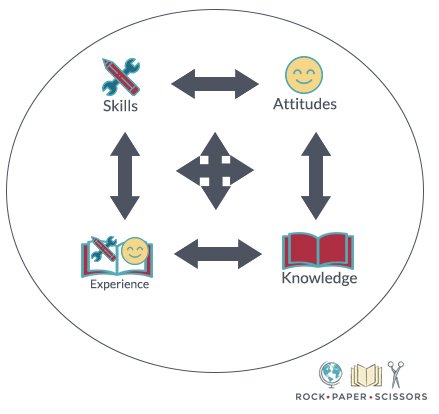
S.A.K.E.
S
S stands for skills.
Learning about something new almost always includes learning a skill.
Example: If I were to teach you how to swim, for example, a skill you might want to learn is how to swim two lengths of the pool doing the front stroke.
A
A stands for Attitude.
This is the one that people tend to either automatically, unconsciously, and naturally include 100% or ignore altogether.
When we talk about attitude, we are talking about vision, mission, and motivation. It’s all about getting learners on board and excited to learn. If attitude isn’t in place, it’s like pushing a five-ton boulder up Mount Everest.
Example: using the swim example again, I would want to motivate you to see the bigger picture and be motivated about staying safe around the water, and why that’s key. I’d want you to feel encouraged, supported, and confident.
K
K stands for knowledge.
Learning something new always involves new knowledge, incorporating new theories, research, perspectives, etc.
Example: again with swimming, in teaching you the front crawl, I’d want to teach you the position to hold both your arms and head while you take a breath.
E
E stands for experience.
It’s all about how the learner experiences their learning outside of the classroom (regardless whether the classroom is sitting under a tree, around a board table, or in front of a Zoom or MS Teams screen). It’s all about how to “get the learning to leave the room,” how to apply and transfer the learning.
Example: if I were teaching you to swim, I’d want to eventually get you to the point where you didn’t need me, and you could go swimming safely and confidently on your own.
Here’s the thing, though
When we think about the S.A.K.E., we will always have a bias or a preference for one or two of the elements.
I once did a S.A.K.E. workshop for a group of university instructors, and guess which one they preferred? I’ll give you three guesses, and the first two don’t count.
They were all in for Knowledge.
What about you?
Think about the last time you set out to learn something. Were you focused on learning how to do something (Skill), or were you really motivated and keen to incorporate your learning into your vision (Attitude)?
Or perhaps you wanted to learn some new theories, some new research, etc., (Knowledge), or maybe you were focused on what to do with all this learning long after you left the “classroom” (Experience).
This bias or preference is everything because it completely affects how we design workshops.
For example, if you’re really into theory and research and you have the best cited sources from here to Timbuktu, then you’re showing your knowledge bias.
Annnnnd you may be a risk for leaving behind the learners who are focused on other parts of the S.A.K.E.
If you are focused on skill building, then you’ll automatically build in lots of time for practice. And potentially leave behind others who are looking for the other S.A.K.E. elements.
Can you guess which of the four components is most important to people overall (and how I know this)?
I can tell you because I’ve been surveying people about this for a long time when I do my Training for Trainers workshops. The number one thing that people are looking for never changes!
I’m serious. Despite working with people from all over the world, the number one thing that they’re looking for in a workshop that has never changed over time is …..
Can you guess what it is?
Before I tell you, though, which of the four components do you think is the one that gets included the least – is it skills, knowledge, attitude, or experience?
Here’s your answer…

The heartbreaking, gut-clenching, hand-wringing, tear-jerker of the truth is that the thing people are most looking for is the thing that gets included at least in workshops.
You read that right.
The thing people want the most is the thing that’s included the least.
So, what is it?
It’s Experience.
People want to do something with their learning. They want to apply their learning. They want to make a difference long after they leave the “classroom.”
Yes, workshops rarely encourage that.
Insert a sniffle and sob here.
But don’t lose hope.
Check out the resources below, including how you can find your own bias for your learning and your teaching (and then be sure to design inclusively).
Now get going for your sake and your community’s S.A.K.E.
Now go on and learn, laugh, and lead
Learn
- Take my learning preference survey here and find out where your bias lies.
Laugh
- If only it were that simple. Designing and delivering powerful learning is complicated, kinda like this.
Lead
- The next time you set out to design and deliver a workshop, for everyone’s S.A.K.E., make sure you’re including all four: skills, attitude, knowledge, and experience.
P.S.
- Have you heard the big news?! I’ve launched the Transformative Trainers Academy. Curious? Check it out. Share it with a friend or colleague. If you refer someone, you’ll get your first month’s membership for free!
P.S.
- Grab your spot now for the September 11th Learning and Development Roundtable “From What’s In It for Me to What’s In It for Us: Getting Results with Your Personal Operating Manual (POM)” and, even better, invite a colleague and/or friend.


Leave a Reply